![[personal profile]](https://www.dreamwidth.org/img/silk/identity/user.png) gravityeyelids
gravityeyelidsvia http://ift.tt/2dQ1DRw:
The only indication we have that they may have known–besides their dealings with Claudius–is Hamlet’s explanation to Horatio:
Why, man, they did make love to this employment!They are not near my conscience; their defeat Does by their own insinuation grow. ‘Tis dangerous when the baser nature comes Between the pass and fell incensed points Of mighty opposites.
Horatio accepts it but this it’s still pretty ambiguous. Did they know they were, theoretically, taking Hamlet to his death? Shakespeare doesn’t give us that certainty, one way or the other. If they did know theoretically they might have still delivered the letter on expectation that if Hamlet washed up in England he would have been put to death, but again, that’s pure speculation. Is it more likely that Hamlet sent his erstwhile friends to their deaths as an act of misguided revenge? Possibly. As heroes go, Hamlet is certainly not a spotless one.
Want to have your mind blown further?
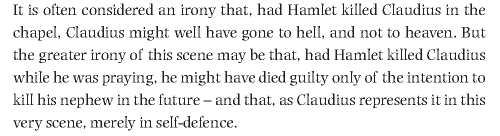
Read the play-within-a-play scene again. Claudius sits through the dumbshow–which explicitly depicts the poisoning, in one of the most verbose stage directions Shakespeare ever wrote–without comment. It’s not until ‘Lucianus’ enters to poison Gonzago that he leaps up and shouts for lights. This doesn’t look like much until you realize one crucial difference: the murderer is not identified until after the dumbshow, by Hamlet himself, as “one Lucianus, nephew to the King.” And when the Gonzago’s nephew poisons him, that is when Claudius leaps up and calls for lights. So while most people–Hamlet included–see this as an admission of guilt, does it not also seem possible that he’s just reacted to a play about a nephew murdering his uncle put on by his own nephew? Maybe it’s not guilt. Maybe it’s fear. In the subsequent chapel scene at first glance it looks like Claudius is admitting to the murder of Hamlet I–and maybe he is–but if you really pick through the tortuous language, it’s also possible he hasn’t committed a murder at all, and that he is instead intending to commit one. The references to wronging a brother and spilling a brother’s blood could equally apply to the literal murder of his brother or to the incestuous act of marrying his brother’s wife (remember those were the grounds on which Henry VIII got his marriage to Katharine of Aragon annulled) and the murder of his brother’s son–which he is now contemplating, and which he obliquely directs Rosencrantz and Guildenstern to carry out. Andrew Zurcher can explain this theory better than I can, so check out his book Shakespeare and Law and the chapter on Hamlet but here’s the upshot:
You might be thinking ‘but what about the Ghost, who tells Hamlet that he was murdered by his brother?’ Fair enough, but even Hamlet and Horatio aren’t sure whether the ghost is a real reflection of Hamlet I or a conjuration of the devil. They question the Ghost’s veracity constantly (in Act I and elsewhere) and it’s Claudius’s starting up at the play that finally convinces Hamlet that he is, in fact guilty. But is he really? Or is he just afraid for his life, after watching a play wherein a jealous nephew murders his uncle? In a play like Hamlet, where the main character’s sanity is never certain, it’s hard to know. Just a nugget for those of you who like Shakespiraces.
The only indication we have that they may have known–besides their dealings with Claudius–is Hamlet’s explanation to Horatio:
Why, man, they did make love to this employment!They are not near my conscience; their defeat Does by their own insinuation grow. ‘Tis dangerous when the baser nature comes Between the pass and fell incensed points Of mighty opposites.
Horatio accepts it but this it’s still pretty ambiguous. Did they know they were, theoretically, taking Hamlet to his death? Shakespeare doesn’t give us that certainty, one way or the other. If they did know theoretically they might have still delivered the letter on expectation that if Hamlet washed up in England he would have been put to death, but again, that’s pure speculation. Is it more likely that Hamlet sent his erstwhile friends to their deaths as an act of misguided revenge? Possibly. As heroes go, Hamlet is certainly not a spotless one.
Want to have your mind blown further?
Read the play-within-a-play scene again. Claudius sits through the dumbshow–which explicitly depicts the poisoning, in one of the most verbose stage directions Shakespeare ever wrote–without comment. It’s not until ‘Lucianus’ enters to poison Gonzago that he leaps up and shouts for lights. This doesn’t look like much until you realize one crucial difference: the murderer is not identified until after the dumbshow, by Hamlet himself, as “one Lucianus, nephew to the King.” And when the Gonzago’s nephew poisons him, that is when Claudius leaps up and calls for lights. So while most people–Hamlet included–see this as an admission of guilt, does it not also seem possible that he’s just reacted to a play about a nephew murdering his uncle put on by his own nephew? Maybe it’s not guilt. Maybe it’s fear. In the subsequent chapel scene at first glance it looks like Claudius is admitting to the murder of Hamlet I–and maybe he is–but if you really pick through the tortuous language, it’s also possible he hasn’t committed a murder at all, and that he is instead intending to commit one. The references to wronging a brother and spilling a brother’s blood could equally apply to the literal murder of his brother or to the incestuous act of marrying his brother’s wife (remember those were the grounds on which Henry VIII got his marriage to Katharine of Aragon annulled) and the murder of his brother’s son–which he is now contemplating, and which he obliquely directs Rosencrantz and Guildenstern to carry out. Andrew Zurcher can explain this theory better than I can, so check out his book Shakespeare and Law and the chapter on Hamlet but here’s the upshot:
You might be thinking ‘but what about the Ghost, who tells Hamlet that he was murdered by his brother?’ Fair enough, but even Hamlet and Horatio aren’t sure whether the ghost is a real reflection of Hamlet I or a conjuration of the devil. They question the Ghost’s veracity constantly (in Act I and elsewhere) and it’s Claudius’s starting up at the play that finally convinces Hamlet that he is, in fact guilty. But is he really? Or is he just afraid for his life, after watching a play wherein a jealous nephew murders his uncle? In a play like Hamlet, where the main character’s sanity is never certain, it’s hard to know. Just a nugget for those of you who like Shakespiraces.


